Condensing Beehives: Rethinking How We Overwinter Honey Bees
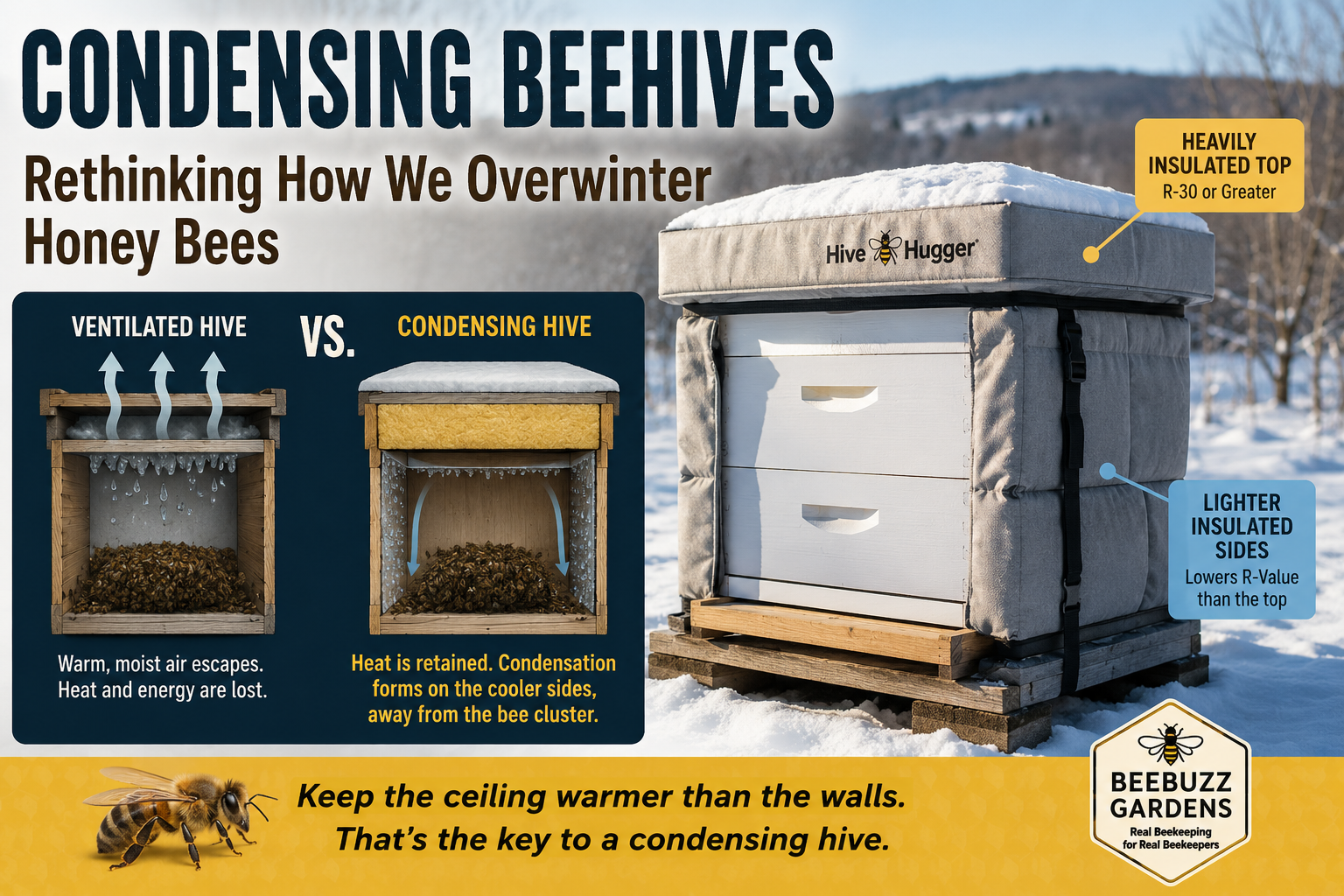
For many northern beekeepers, preparing colonies for winter has traditionally meant wrapping the hive, providing an upper entrance or ventilation opening, and trying to remove moisture produced by the colony.
But what if we have been thinking about winter moisture the wrong way?
Recently, the Leatherstocking Beekeepers Association hosted beekeeper Peggy DeSanto, co-founder of Hive Hugger, for a Zoom presentation about the difference between traditional ventilated hives and what are known as condensing hives.
Peggy's presentation challenged some long-standing ideas about winter ventilation and offered an interesting alternative: instead of trying to remove warm, moist air from the hive, conserve the colony's heat and control where condensation occurs.
Her presentation closely follows her video:
Ventilated Hive vs. Condensing Hive & Intro to Hive Hugger
The concept is particularly interesting to me as a beekeeper here in Central New York, where colonies have to survive months of freezing temperatures, snow, wind, and rapidly changing winter weather.
The Traditional Ventilated Hive
Many of us were taught that moisture kills bees, not cold.
The reasoning makes sense.
Honey bees generate heat during winter by clustering and consuming stored honey. Respiration and the metabolism of that honey also produce water vapor.
Warm, moist air rises.
When that air reaches a cold inner cover or hive surface, water can condense. If cold water drips back onto the winter cluster, the bees can become chilled.
The traditional solution has therefore been to get that moisture out of the hive.
Beekeepers accomplish this in several ways:
- Upper entrances
- Ventilation holes
- Notched inner covers
- Quilt boxes
- Vivaldi boards
- Moisture-absorbing materials
These methods attempt to allow warm, humid air to escape before it becomes a serious condensation problem.
There is, however, a tradeoff.
That warm air contains heat the bees worked very hard — and consumed honey — to produce.
A condensing hive takes a different approach.
What Is a Condensing Hive?
Despite the name, the goal isn't to create a soaking-wet hive.
Instead, a condensing hive attempts to control the temperature of different surfaces inside the hive so condensation occurs in safer locations.
The most important principle is surprisingly simple:
«Keep the ceiling warmer than the walls.»
This is accomplished by putting substantially more insulation above the colony than around the sides of the hive.
Rather than allowing warm air to escape through upper ventilation, the hive retains that heat.
Because the ceiling is heavily insulated, its inside surface remains relatively warm.
The walls remain somewhat cooler.
When condensation does occur, it is therefore encouraged to form primarily on the cooler side walls, rather than directly above the winter cluster.
The moisture can run down the sides of the hive, and bees may also have access to some of that water when they need it.
Think About a Bee Tree
One of the most interesting parts of the condensing-hive discussion is how closely the idea relates to the natural homes of honey bees.
Honey bees didn't evolve inside thin wooden Langstroth boxes.
Wild colonies commonly occupy cavities inside trees.
A tree cavity can provide considerable thermal mass and insulation. The cavity has no beekeeper drilling ventilation holes through the top of it every autumn.
The colony itself regulates its environment.
That doesn't mean we can simply declare a Langstroth hive equivalent to a hollow tree. It isn't.
But studying natural colonies raises an important question:
Should our winter hive management work with the bees' ability to regulate their environment rather than constantly venting that environment to the outside?
That's one of the ideas behind the condensing-hive approach.
Heat Is Energy — and Energy Comes From Honey
A winter bee colony isn't heating the entire hive to summertime temperatures.
The bees primarily maintain the temperature of the cluster.
Producing that heat requires energy.
And their winter energy source is honey.
When we continually allow warm air to escape through the top of the hive, the colony must compensate for some of that heat loss.
That means consuming additional stores.
Better insulation reduces the rate at which heat moves from the warmer hive interior into the much colder outside environment.
The principle isn't much different from insulating a house.
We don't heat our homes in January and then intentionally leave an upstairs window open because we're worried about condensation.
Instead, we insulate the building and control moisture.
The condensing hive applies a similar idea to the bee colony.
The Top Is the Most Important Part
One point emphasized in discussions of condensing hives is that all insulation is not equal.
Heat rises, making the top of the hive particularly important.
The condensing-hive model therefore calls for considerably greater insulation above the colony than along the hive walls.
Peggy's Hive Hugger recommendations, for example, call for approximately R-30 or greater insulation above the hive in colder climates, while the walls receive substantially less insulation.
The exact materials aren't the important part of understanding the concept.
The temperature relationship is.
Top = very well insulated
Sides = insulated, but cooler than the top
That temperature difference helps determine where the dew point is reached and therefore where condensation forms.
What About Moisture?
This is probably the part that initially makes many experienced beekeepers uncomfortable.
We've spent years hearing:
«Moisture kills bees.»
There's truth behind the warning, but it needs an important qualification.
Moisture dripping onto the winter cluster is dangerous.
Moisture simply existing somewhere within the hive isn't necessarily the same thing.
Honey bees require water.
Even during winter, they need water to help process and dilute stored honey.
The condensing-hive concept therefore doesn't attempt to eliminate every molecule of water vapor.
Instead, it tries to manage the moisture so that condensation occurs away from the cluster — primarily along the cooler walls.
That is a very different strategy from attempting to vent moisture completely out of the colony.
No Upper Entrance?
This is another major difference between the two systems.
A true condensing-hive configuration generally does not use an upper entrance or upper ventilation opening.
The lower entrance remains.
Removing the upper opening prevents the hive from functioning like a chimney.
Warm air rising through the colony isn't immediately exhausted outside.
That allows more of the colony's heat to remain inside the hive.
For beekeepers who have spent decades providing upper winter entrances, this can seem completely backward.
And that's exactly why the subject deserves discussion.
What About Quilt Boxes?
Traditional quilt boxes absorb moisture reaching the top of the hive.
They can certainly help keep condensation from dripping directly onto bees.
But they represent a different philosophy from the condensing hive.
A quilt box essentially says:
Moisture reached the top, so let's absorb it.
The condensing-hive philosophy says:
Let's keep the ceiling warm enough that significant condensation doesn't form there in the first place.
For that reason, moisture-absorbing quilt boxes and similar systems generally aren't part of a true condensing-hive setup.
Colony Size Still Matters
Insulation cannot compensate for every problem inside a colony.
A small winter cluster inside a huge stack of mostly empty equipment has considerably more space surrounding it than necessary.
One recommendation associated with this approach is to match the hive volume to the size of the colony.
If the colony doesn't require three boxes, don't automatically overwinter it in three boxes simply because that has traditionally been the winter configuration.
Colonies still need adequate food stores, healthy winter bees, good queens, and — critically — proper Varroa management.
A well-insulated hive isn't a substitute for good beekeeping.
Where the Hive Hugger Fits In
Peggy DeSanto's interest in this subject eventually led to the development of the Hive Hugger winter insulation system.
The system essentially provides two different levels of insulation.
The Crown heavily insulates the top of the colony.
The Wrap insulates the hive walls.
The Crown uses a high-R-value vacuum insulation panel while the wrap provides lower insulation around the sides.
That difference is intentional.
It creates the thermal arrangement required by the condensing-hive model: the ceiling stays warmer than the walls.
It's worth pointing out that you don't necessarily have to purchase a commercial Hive Hugger to experiment with the underlying principles.
Hive Hugger is one implementation of the broader condensing-hive concept.
Beekeepers can study the principles and construct their own insulation systems using appropriate materials, provided they understand what they're trying to accomplish.
Condensing Hive vs. Ventilated Hive
The fundamental difference can be summarized fairly simply.
Traditional ventilated hive
Warm moist air rises → moisture is vented or absorbed → heat leaves the colony → bees consume additional energy replacing some of that lost heat.
Condensing hive
Warm moist air rises → heavily insulated ceiling remains warmer → heat is retained → cooler walls become the preferred condensation surfaces → moisture stays away from the cluster.
Neither description eliminates all of the complicated physics and biology occurring inside an overwintering bee colony.
But it illustrates the dramatically different philosophy behind the two systems.
Something Worth Experimenting With
One thing I've learned during my years of keeping bees is that beekeeping is constantly evolving.
Some practices that were considered unquestionable decades ago are now being reevaluated as researchers put temperature sensors, humidity sensors, scales, thermal cameras, and other instruments inside colonies.
The condensing-hive discussion is a good example.
Instead of simply accepting:
"We've always ventilated our hives this way."
we can ask:
Why?
What happens to colony temperature?
Where does the moisture actually go?
How much honey does the colony consume?
How does insulation affect the winter cluster?
And perhaps most importantly:
What are the bees themselves trying to accomplish?
Those are questions worth asking.
For northern beekeepers — especially those of us dealing with winters like we have here in Central New York — conserving the colony's heat while safely controlling condensation certainly deserves serious consideration.
Watch Peggy DeSanto's Presentation
If you're interested in the subject, I highly recommend watching Peggy's complete presentation.
Ventilated Hive vs. Condensing Hive & Intro to Hive Hugger
The video goes much deeper into the reasoning, research, temperature management, insulation and development of the Hive Hugger system than I can cover in a single article.
This article is an educational summary and discussion inspired by Peggy DeSanto's presentation on ventilated and condensing hives. Hive Hugger is a commercial product developed by Bee the Change LLC. BeeBuzzGardens is not affiliated with or sponsored by Hive Hugger.
Happy beekeeping,
Clifford BeeBuzzGardens.com